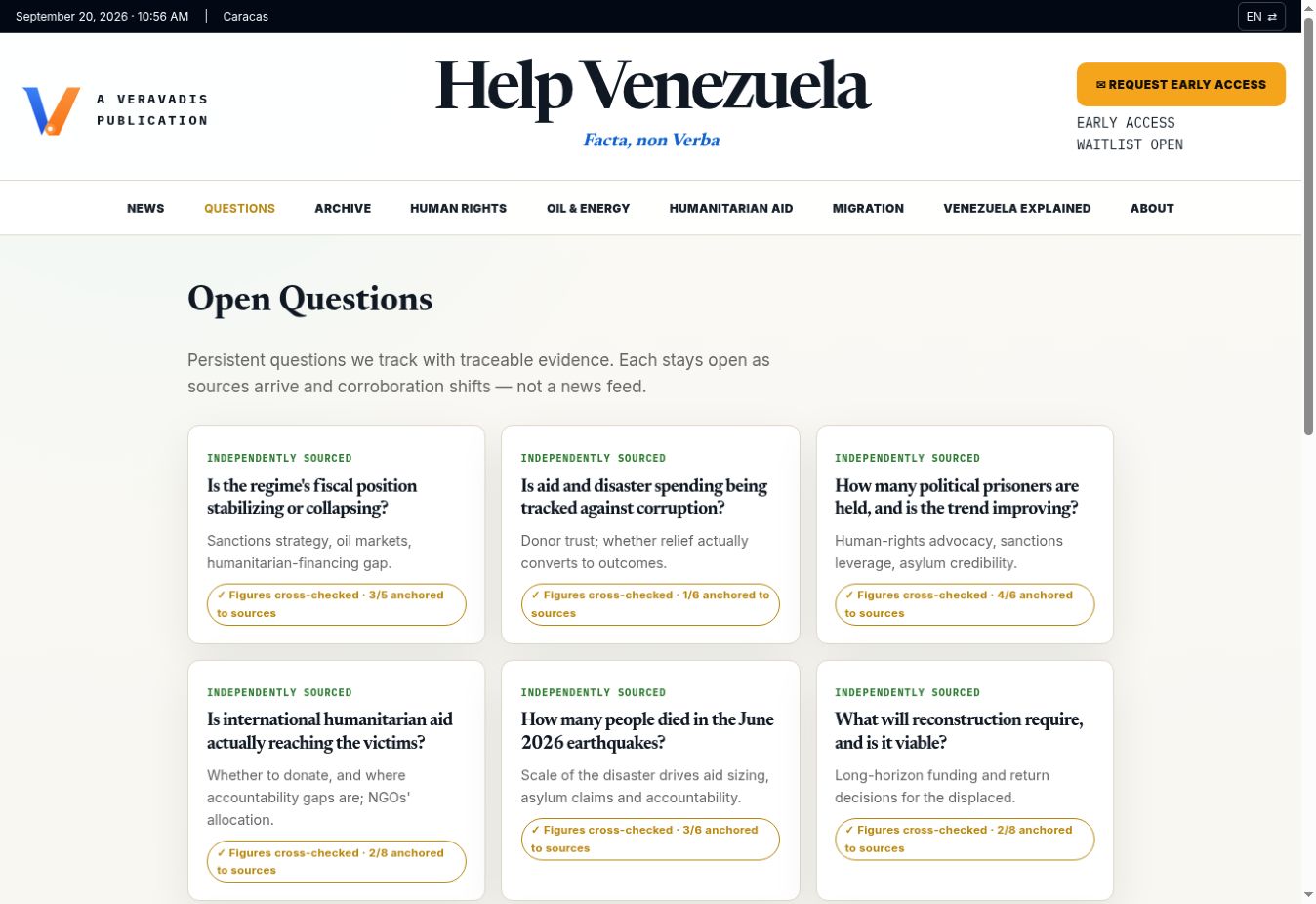
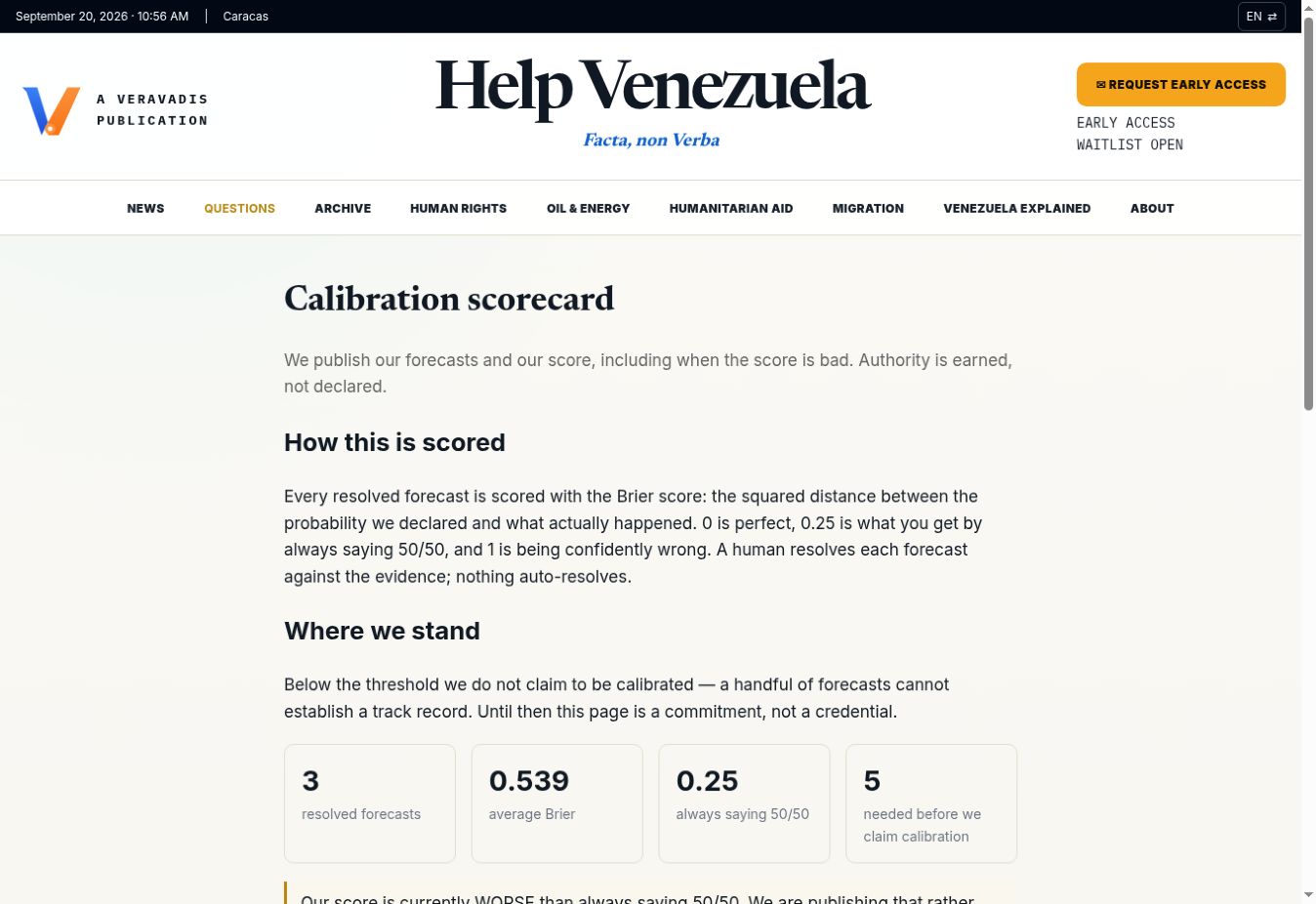
VENEZUELA / LIVE
HelpVenezuela
Source-aware briefs, persistent open questions, corrections, verification methodology, and a public calibration record.
Visit helpvenezuela.orgA more verifiable view
of a complex world
VeraVadis turns news flows, documents, and open signals into living, traceable events—without collapsing observation, inference, hypothesis, and uncertainty into one opaque score.
For researchers, journalists and risk analysts who need to see why an assessment exists — and where it could be wrong.
Repetition is not corroboration.
Methodology · How it works
Each public brief links back to the sources beneath it. Stages marked “in development” are not finished; the status map lists what is available today.
News, primary documents, records, monitored media, and open signals enter with source identity and time attached.
Documents are broken into atomic assertions, each with its speaker and a verbatim quote.
In development · status map
Lineage separates independent reporting from republished copies: aggregators are not roots, each news agency counts once, and one figure repeated by many outlets traces back to one origin.
In development · status map
Entities, claims, and their relationships are stored in a knowledge graph.
In development · status map
The public piece separates what the sources establish from what remains unverified—and each open question states what would change the assessment.
Regions · Regional publications
Regional publications apply the same evidence doctrine to a specific information environment. Availability is stated plainly.
VENEZUELA / LIVE
Source-aware briefs, persistent open questions, corrections, verification methodology, and a public calibration record.
Visit helpvenezuela.orgREGIONAL EDITION
REGIONAL EDITION
REGIONAL EDITION
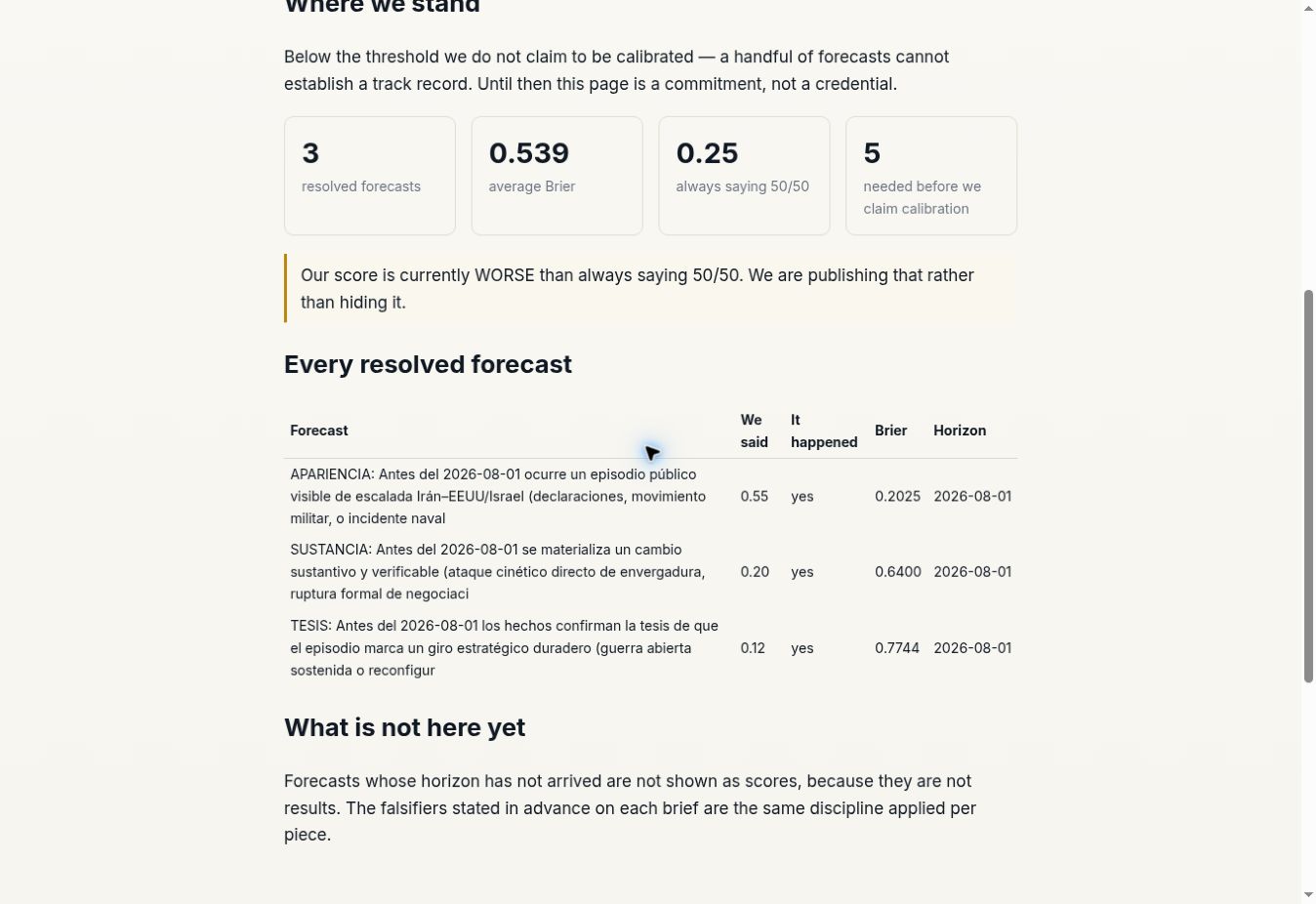
The HelpVenezuela images above are captures of live pages, taken September 20, 2026. They may not match the pages today. The other editions are future plans, not product claims.
Why VeraVadis
VeraVadis is not an enterprise real-time alerting platform. It is built for a narrower question: can a reader inspect why an assessment exists?
Target model, not yet released. Today HelpVenezuela publishes two layers: what the sources establish (Observed) and what remains unverified (Inferred, Hypothesis and Unknown are not yet separated). Its per-question labels, such as “Emerging”, describe how much sourcing sits behind a question, not the epistemic state of a claim.
Unanswered questions and missing evidence remain visible rather than being absorbed into confident prose.
Ten headlines from one wire story remain one informational root.
Each open question keeps its missing evidence and what would change the assessment in view. Contradiction tracking: see the status map.
HelpVenezuela publishes its average Brier score instead of hiding it: 0.539 across 3 scored tiers of one resolved event (Iran–US/Israel), as of 2026-09-23 — too few to assess calibration; lower is better, 0.25 = always saying 50/50.
Inspect the scorecardAbout · Operating doctrine
VeraVadis is built by MindWareHouse . VeraVadis is the evidence engine; HelpVenezuela is its live public showcase; MindWareHouse builds and operates it.
“Publish what the evidence supports. Preserve what it does not. State what would change the judgment.”
Status · What exists today
One list, read from a dated registry. Nothing in development or planned is presented as released.
Registry as of Sep 23, 2026; next review by Oct 23, 2026. Links marked ↗ open the evidence on helpvenezuela.org.
Early-stage infrastructure
Who it's for
VeraVadis is recent, selectively opened, and still being built. Explore the regional publication already in production or request a research conversation.
What you get: a conversation about your question and how the method applies to it. Who it suits: people working on Venezuela today. Not available yet: self-service access or accounts.
Requests are answered for now by the HelpVenezuela editorial desk at director@helpvenezuela.org. The email opens with three lines to fill in: organization, the question you are researching, and intended use.